TL;DR: If a pipe just burst in your Auburn home, shut off the main water valve and the breaker to any wet electrical area first. Then make two calls: a plumber to stop the source permanently, and a water damage restoration company to start extraction and drying within hours, before mold sets in. Most homeowners policies cover sudden, accidental pipe bursts, not gradual leaks.
If you’re standing in ankle-deep water right now with a pipe still spraying behind a wall or under a sink in your Auburn, Worcester, or Shrewsbury-area home, stop reading after this paragraph and go shut off the water. The rest of this guide tells you exactly what to do next, who actually needs to come out, and what to expect over the next 24 hours.
What do you do in the first 60 seconds?
Shut off the main water supply valve immediately, then kill power to any circuit near standing water at the breaker panel, not at the outlet.
The main shutoff is usually near the water meter, in the basement, a utility closet, or where the line enters the home from the street. Turning it clockwise stops water flow to the whole house, not just the broken fixture. If you can’t find it or it won’t turn, shut off the smaller valve directly under the fixture that failed (a toilet, washing machine, or sink line) instead of losing time.
Never step into standing water near an outlet, a baseboard heater, or a panel box until the power to that area is off. If the water is near your electrical panel itself, stay out of the room and call your utility company before touching anything.

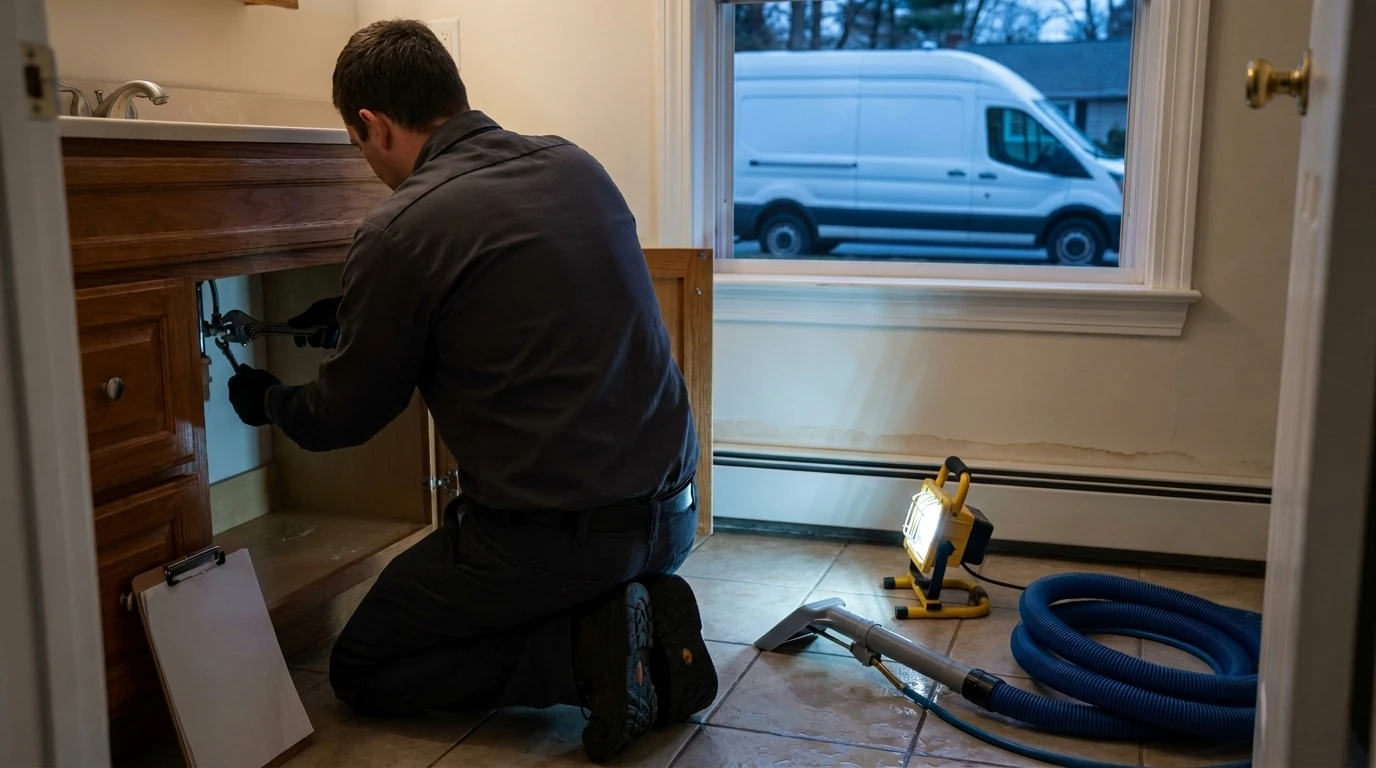
Recent job photo from QCI Restoration.
Who do you call first, a plumber or a restoration company?
Call both, right away, because they solve two different problems. A plumber finds and repairs the broken pipe so water stops for good; a water damage restoration company removes the standing water and dries the structure before mold or rot sets in.
If you only call a plumber, the leak gets fixed but the wet drywall, subfloor, and insulation keep sitting there. Materials start growing mold within 24 to 48 hours in a closed-up Massachusetts home, according to the EPA’s guidance on flooded homes. If you only call a restoration crew, they can extract water and set up drying equipment, but the pipe is still broken and water keeps coming back.
For the restoration half, which is usually the bigger job, QCI Restoration answers 24/7 and can mobilize extraction and drying equipment the same day for Auburn and nearby towns. Give them the address and a quick description of where the water is coming from so the crew arrives with the right gear.
What happens in the first 24 hours after the water stops?
The first 24 hours are about getting standing water out and getting air moving through wet materials, not repairs or rebuilding yet. That part comes later, once the structure is dry.
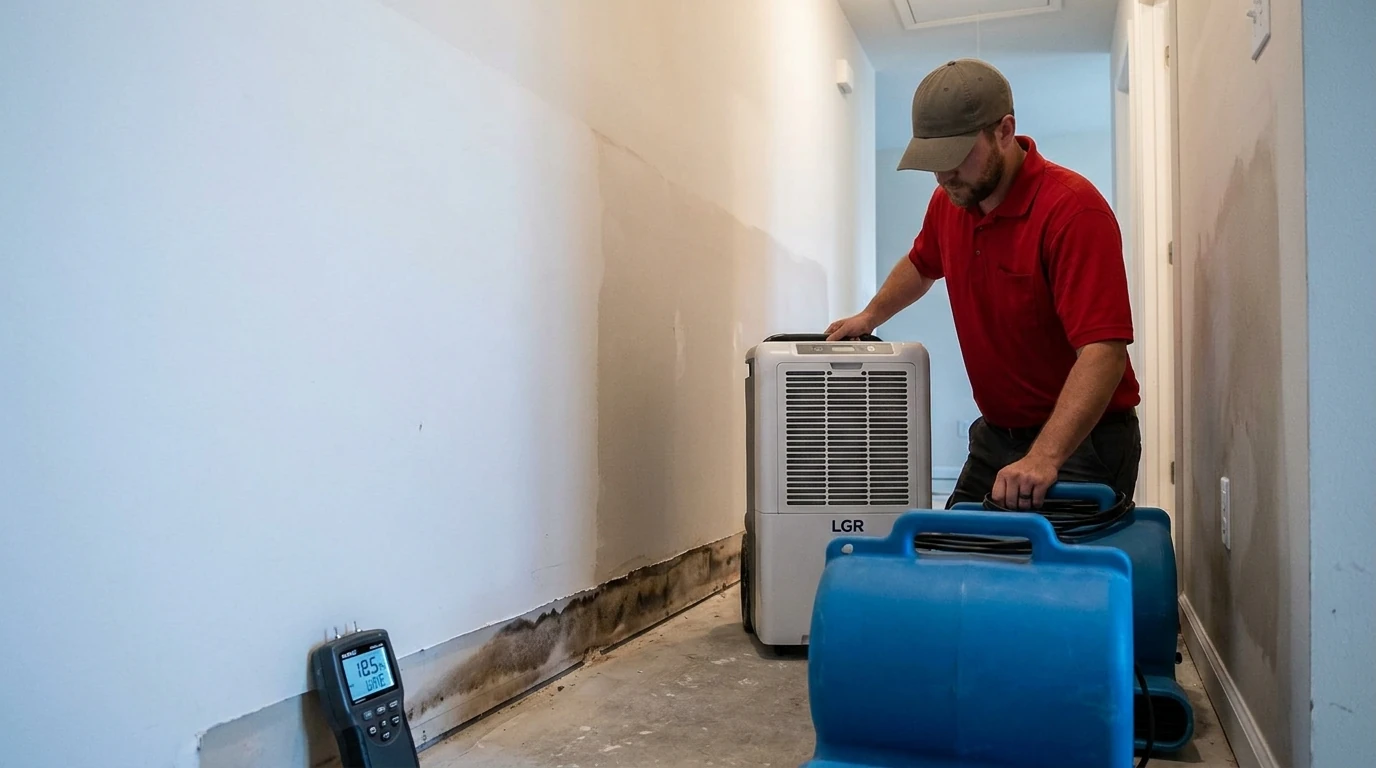
A restoration crew typically starts with a walk-through using a moisture meter to map exactly which walls, floors, and cavities got wet, since water travels further than it looks. Standing water gets pulled out with truck-mounted or portable extraction equipment. Then air movers and LGR dehumidifiers go in to pull moisture out of drywall, subfloor, and framing, following the drying principles in the S500 water damage standard.
Anything soaked that can’t be dried fast enough, like baseboards, carpet pad, or water-logged insulation, usually gets removed in this window rather than left to grow mold. Our burst pipe emergency checklist covers what to photograph and remove before the crew arrives if you have a few extra minutes.
Will homeowners insurance cover a burst pipe in Auburn?
Most Massachusetts homeowners policies cover water damage from a burst pipe because it’s sudden and accidental, not a slow, known leak you ignored.
The Insurance Information Institute notes that standard policies generally pay for sudden pipe failures but exclude damage from gradual seepage or a leak you knew about and didn’t fix. Your adjuster will want photos of the damage, the extraction and drying invoice, and often moisture readings showing the structure actually dried out, not just that water was removed.
Keep every receipt and ask your restoration company for a written scope of work and drying logs; that documentation is what turns a claim into a paid claim. Costs vary by how much water spread and how long it sat, so get a written estimate before anyone signs off on repairs.
What should you do next?
Shut off the water, call a plumber for the repair, and call a restoration crew for extraction and drying, ideally within the same hour. The faster drying starts, the less of your home has to be torn out and rebuilt.
This is also where the “One Call Does It All” idea actually matters in a burst pipe emergency: instead of juggling a plumber, a drying crew, a drywall contractor, and a painter separately, one coordinated team can carry the loss from mitigation through the full rebuild. Request a water damage restoration assessment as soon as the water stops, not after you’ve tried to dry it out yourself with fans.
About QCI Restoration
QCI Restoration is based in Auburn, MA and answers emergency calls 24/7 across Central Massachusetts and Greater Worcester, including Shrewsbury, Westborough, and Framingham. Their crews handle water damage restoration, fire and smoke cleanup, sewage cleanup, mold remediation, and full reconstruction under one roof, so a burst pipe can go from extraction to finished drywall without coordinating separate contractors. Holding a 4.5 rating across 115 Google reviews, the company positions itself around a simple idea: one call covers the loss from start to finish.
Need help now? Call QCI Restoration at (508) 756-8800.