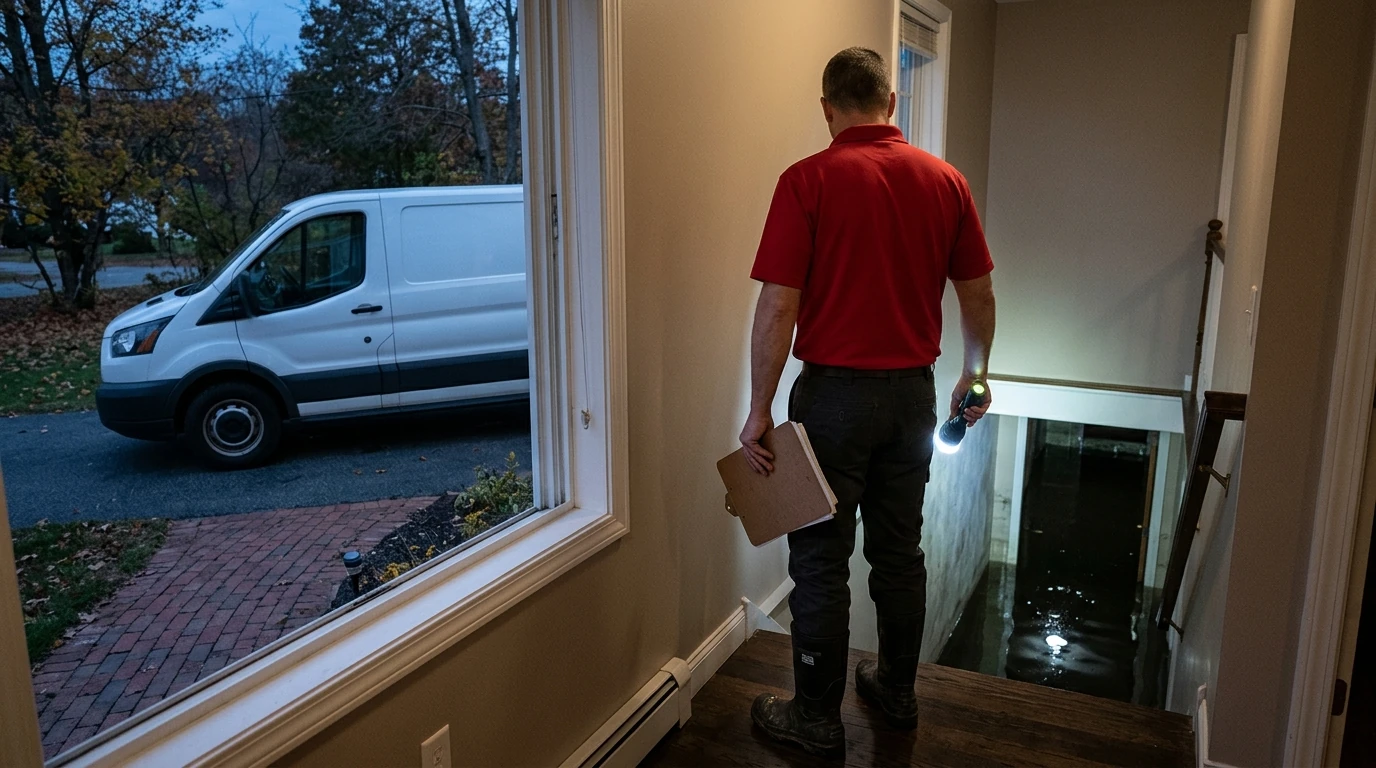
For a sewage backup in Auburn, MA, call QCI Restoration at (508) 756-8800. The company runs 24/7 and is for water and sewage damage cleanup, so one call can start clearing the line and begin the Category 3 cleanup. If sewage is actively coming up through a drain or toilet right now, stop using every sink, toilet, and appliance in the house before you do anything else, you don’t want to add more volume to a line that’s already backed up.
Sewage Backed Up Into My Basement: What Do I Do in the First Hour?
Stop using water anywhere in the house, keep people and pets out of the affected area, and call for help before you touch anything. Raw sewage is Category 3 black water under the IICRC S500 standard, the most contaminated water category there is, and it can carry bacteria, viruses, and parasites that ordinary household cleaning won’t remove.
In the first hour:
- Shut off water use in the home: no flushing, no laundry, no dishwasher, no running faucets.
- Keep kids, pets, and anyone with a compromised immune system away from the area.
- Don’t wade into standing water without rubber boots and gloves at minimum.
- Photograph the damage before anything is moved or thrown out, you’ll need it for the insurance claim.
- If the backup is coming up through a basement floor drain, that usually points to the main line rather than a fixture inside the house.
Older homes around Auburn, including houses near Pakachoag Hill and along the Oxford Street corridor, often have sewer laterals that are decades old. Those lines back up more often during heavy rain, when the municipal main is already running near capacity.
Plumber, Town Sewer Department, or Restoration Company: Who Do I Call?
Call a plumber when the blockage is inside your own lateral line, call Auburn’s public works or sewer department when the backup is coming from the municipal main, and call a restoration company for the Category 3 cleanup, disinfection, and drying once the water stops. Most backups need more than one of these calls, in that order.
A plumber’s job is clearing the obstruction, usually by snaking the line and running a camera inspection to confirm it’s clear. If the backup is inside your own lateral, this is where it starts.
The town’s sewer department gets involved when the problem is the municipal main itself, not your line. If neighbors on the same street are also reporting backups, or your plumber finds no clog near the house, that’s a sign the issue is upstream and belongs to the town, not to you.
A restoration company handles everything after the water stops flowing: removing contaminated materials, disinfecting the area, and drying it to the IICRC S500 standard. This is the logic behind a “One Call Does It All” model, one contractor who handles the plumbing fix, the Category 3 cleanup, and the rebuild work afterward, so you’re not juggling three separate schedules during an already stressful week.
Is It Safe to Stay in the House With a Sewage Backup?
It depends on how much area is affected, but anyone with young children, a weakened immune system, or respiratory issues should avoid the affected level of the house until cleanup starts. Category 3 water carries pathogens that can cause gastrointestinal illness and skin infections on contact.
If the backup is confined to a small area of an unfinished basement, most households can stay upstairs while cleanup is arranged. If the contaminated water has spread across a finished living space, or odor is noticeable on the main floor, it’s worth limiting time in the house until a crew has assessed it. The CDC’s guidance on cleaning up safely after a disaster treats any contact with sewage-contaminated water as a health risk that calls for protective equipment, not a quick mop-up.
Why Raw Sewage Cleanup Isn’t a DIY Job
Bleach and a mop will not fully disinfect porous materials that have absorbed Category 3 water, and working without the right PPE puts you at real risk of illness. Carpet, carpet pad, drywall, and insulation that have been in contact with raw sewage typically have to come out, not just get wiped down.
A few reasons this isn’t a weekend project: contaminated water tracks on shoes and tools to unaffected rooms, household cleaners don’t reach pathogens trapped inside porous building materials, and without a moisture meter it’s easy to leave damp framing behind the wall that turns into a mold problem within 24 to 48 hours. If musty odor or visible growth shows up after a backup, that’s a separate call for mold remediation.
What Happens When You Call, and What Gets Thrown Away?
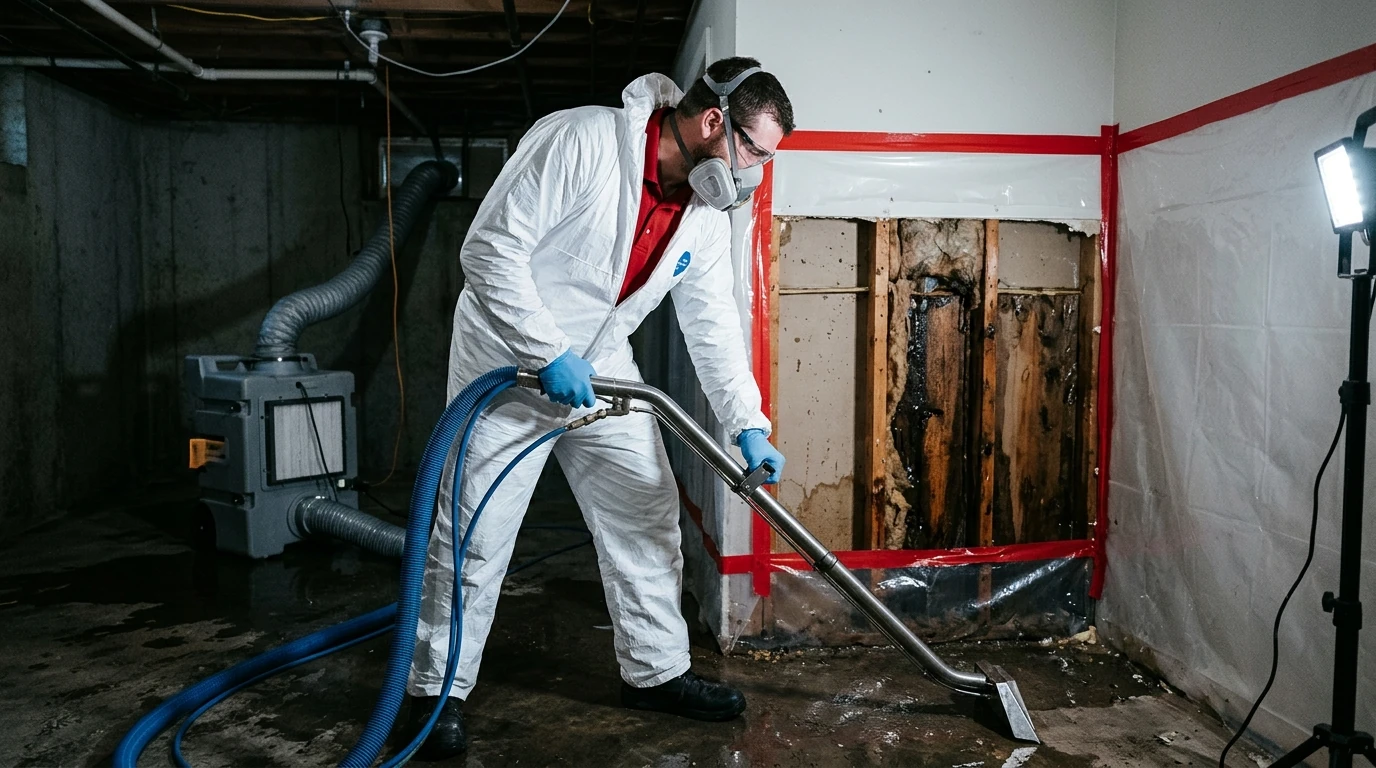
When you call, a technician assesses the affected area, confirms the water category, and sets up containment before removing anything. From there, the work generally follows a set sequence: extraction of standing water, removal of porous materials that can’t be disinfected, antimicrobial treatment of the remaining structure, and drying with air movers and dehumidifiers until moisture readings return to normal.
Hard-surface flooring and sealed concrete can usually be cleaned and disinfected in place. Carpet, carpet pad, drywall up to the flood line, and insulation that contacted Category 3 water are almost always discarded, that’s standard practice under IICRC guidelines, not an attempt to pad the job. Framing and subfloor can often be saved once it’s dried and tested.
On the insurance side, a standard homeowners policy typically does not cover sewer backups or sump pump failures unless you’ve added a water backup endorsement. Document everything with photos before cleanup starts, keep any emergency mitigation receipts, and call your insurer once the immediate water is under control. Our guide to what homeowners insurance actually covers for water damage walks through what to expect from the adjuster. If the loss isn’t sewage, like a burst pipe or a basement flooded by rainwater or groundwater, see our separate guide on who to call for a flooded basement in Auburn, since that call is handled differently.
The fastest path from a backed-up drain to a dry, disinfected basement is one call that covers the plumbing, the sewage cleanup, and the drying, rather than three separate ones. Call QCI Restoration at (508) 756-8800 to get a technician assessing the damage today.
About the Team Behind This Guide
This guide was prepared by a 24/7 restoration and plumbing company based in Auburn, Massachusetts, rated 4.5 stars across 126 Google reviews. The crew handles emergency plumbing, sewage cleanup, water damage restoration, mold remediation, and the reconstruction that follows a loss, covering the full job under one roof so homeowners aren’t coordinating separate contractors mid-emergency.